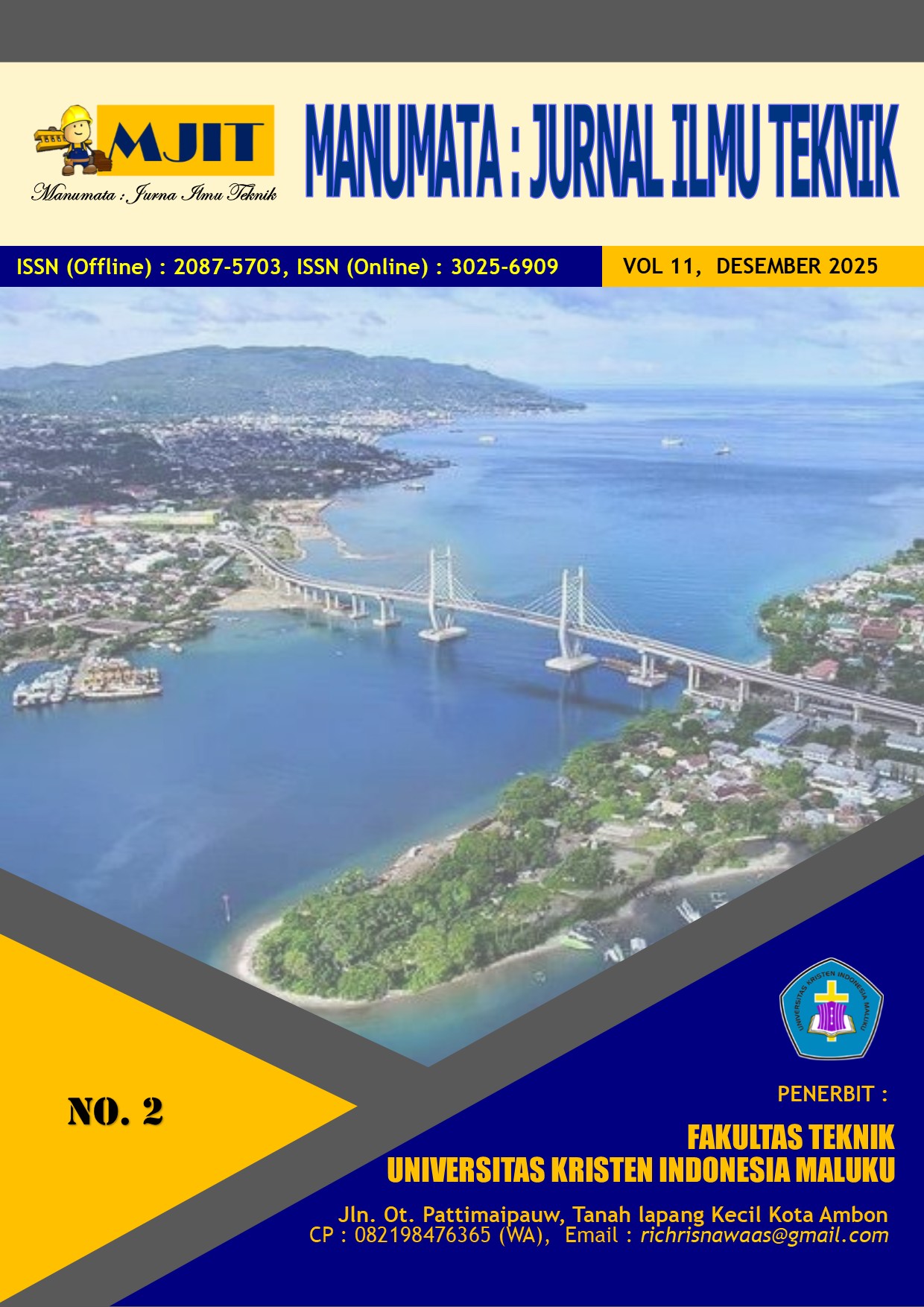
Evaluasi Kinerja Operasional Dermaga Dan Pelayanan Pada Pelabuhan Penumpang Slamet Riyadi Kota Ambon
DOI:
https://doi.org/10.51135/manumatav11i2p130-139Keywords:
berth performance, service time efficiency, ET/BT ratio, Berth Occupancy Ratio.Abstract
References
Antara News. (n.d.). KKP kembangkan pelabuhan perikanan ramah lingkungan. https://kepri.antaranews.com/amp/berita/9
/kkp-kembangkan-pelabuhan-
Apriani, R., Azwansyah, H., Rakyat, P., Kuning, N., Pelabuhan, S., Kuning, N., & Pontianak, K. (2017). Evaluasi kinerja pelabuhan Rakyat Nipah Kuning. Jurnal Teknik Sipil, 1 13.
Badan Pusat Statistik. (2020). Statistik transportasi laut 2020. Jakarta: BPS.
Baird, A. J. (1995). Privatisation of trust ports in the United Kingdom: Review and analysis of the first sales. Transport Policy, 2(2), 135 143. https://doi.org/10.1016/0967- 070X(95)93247-S
Direktorat Jenderal Perhubungan Laut. (2011). Keputusan Direktur Jenderal
Perhubungan Laut Nomor UM.002/38/18/DJPL-11 tentang Standar
Perhitungan Kinerja Pelabuhan. Jakarta:
Kementerian Perhubungan. Kementerian Perhubungan Republik
Indonesia. Direktorat Jenderal Perhubungan Laut. Kantor
Kesyahbandaran dan Otoritas Pelabuhan Kelas I Ambon. (2025, 21 Mei).
Penyampaian data operasional, data penumpang dan muatan, dan data fasilitas pelabuhan (5 tahun terakhir) di Pelabuhan Slamet Riyadi [Surat resmi Nomor: UM.006/91/KSOP.ABN-2025]. Ambon: Kementerian Perhubungan Republik Indonesia.
Koran Jakarta. (n.d.). Pelabuhan Tanjung Priok tetap layani ekspor impor.
https://koran-jakarta.com/pelabuhantanjung- priok-tetap-layani-ekspor-impor Kramadibrata, S. (2002). Perencanaan pelabuhan. Bandung: Penerbit ITB.
Mandi, N. B. R. (2015). Pelabuhan: Perancangan, perencanaan bangunan,
konstruksi.
Mangkunegara, A. P. (2012). Evaluasi kinerja SDM. Bandung: Refika Aditama.
Miro, F. (2005). Perencanaan transportasi. Jakarta: Erlangga.
Munah, D. H. (2018). Analysis on performance of Lembar seaport based on the criteria of port performance. Jurnal Teknik Sipil, Universitas Mataram.
Pemerintah Republik Indonesia. (1983). Peraturan Pemerintah Nomor 11 Tahun 1983 tentang Pelaksanaan Pengalihan Bentuk Badan Usaha Milik Negara di Bidang Perhubungan Laut. Lembaran Negara Republik Indonesia Tahun 1983 Nomor 20.
Pemerintah Republik Indonesia. (2008). Undang-Undang Nomor 17 Tahun 2008 tentang Pelayaran. Jakarta: Sekretariat Negara.
Potret Kota. (n.d.). Arus peti kemas Tanjung Perak melonjak 20%. https://potretkota.com/news-1312-aruspeti- kemas-tanjung-perak-melonjak-20
PT Pelabuhan Indonesia (Persero). Cabang Ambon. (2025, 12 Maret). Acc dan aksi [Nota dinas Nomor: 92/UKIM.H5.1.FT/Q/2025]. Ambon: PT Pelabuhan Indonesia (Persero).
Robbins, S. P. (2006). Organizational behavior (12th ed.). New Jersey: Pearson Prentice Hall.
Sedarmayanti. (2011). Manajemen sumber daya manusia: Reformasi birokrasi dan manajemen pegawai negeri sipil. Bandung:Refika Aditama.
Stopford, M. (2009). Maritime economics (3rd ed.). London: Routledge.
Sulfira, A. A. (2018). Analisis evaluasi kinerja pelabuhan perikanan Lampulo dalam peningkatan kesejahteraan hidup dan pengurangan angka pengangguran. Jurnal Ilmiah Manajemen Muhammadiyah Aceh, 7(1), 13 26.
Triatmodjo, B. (2010). Pelabuhan. Yogyakarta: Beta Offset.
UNCTAD. (2016). Port performance indicators. Geneva: United Nations
Conference on Trade and Development.
United Nations Conference on Trade and Development (UNCTAD). (2012). Review of maritime transport 2012. Geneva: United Nations.
Widodo, S. (2012). Manajemen pelabuhan modern. Jakarta: Rajawali Pers.
perikanan-ramah-ling
Downloads
Published
Issue
Section
Citation Check
License
Authors who publish with this journal agree to the following terms:- Authors retain copyright and grant the journal right of first publication with the work simultaneously licensed under a Creative Commons Attribution License that allows others to share the work with an acknowledgement of the work's authorship and initial publication in this journal.
- Authors are able to enter into separate, additional contractual arrangements for the non-exclusive distribution of the journal's published version of the work (e.g., post it to an institutional repository or publish it in a book), with an acknowledgement of its initial publication in this journal.
- Authors are permitted and encouraged to post their work online (e.g., in institutional repositories or on their website) prior to and during the submission process, as it can lead to productive exchanges, as well as earlier and greater citation of published work (See The Effect of Open Access).